
TrimUI Brick vs Miyoo Mini Plus Product Positioning, Display Quality, Build, Ergonomics, and Software Philosophy
When buyers compare the TrimUI Brick vs Miyoo Mini Plus, most articles make the same mistake: they treat them like two interchangeable low-cost vertical handhelds and stop at the obvious differences—screen size, price tier, and community popularity.
That is not a serious comparison.
These two devices occupy the same broad category, but they are built around different design priorities. The Miyoo Mini Plus is best understood as a mature, community-established, classic small-format Linux handheld with a known identity and a very stable place in the retro handheld market. The TrimUI Brick, by contrast, is a newer-generation compact vertical that tries to win on display quality, industrial finish, and overall product polish, rather than simply repeating the Miyoo formula. Public listings and reviews consistently describe the Brick around a 3.2-inch 1024×768 IPS display, Wi-Fi/Bluetooth support, USB-C, and a 3000mAh battery, while the Miyoo Mini Plus is widely listed around a 3.5-inch 640×480 IPS display and is still routinely recommended as a beginner-friendly classic option in the segment.
That distinction matters because the real question is not:
“Which one is better?”
The real questions are:
- Which one has the stronger display implementation for retro content?
- Which one is more coherent as a product?
- Which one is more convincing in the hand?
- Which one is better for a buyer who will actually carry it and use it?
- Which one is easier to recommend without qualification?
- Which one is the better answer to 2026 buyer expectations rather than 2023 category expectations?
My conclusion, stated plainly, is this:
Die TrimUI Brick is the stronger product design.
The Miyoo Mini Plus is the safer product.
Those are not the same thing.
The Brick has a better case if your standard is hardware refinement, display density, and modern compact-device appeal. The Miyoo Mini Plus has a better case if your standard is community familiarity, predictable ownership, and the confidence that comes from buying a device that has already earned its place as a category reference point. Public commentary around the Brick increasingly frames it as a compact handheld with an unusually crisp display and strong pocketability, while long-running guides for the Miyoo Mini/Plus ecosystem continue to emphasize setup resources, custom OS pathways, and the stability of its user base.
This first part focuses on the foundations of the comparison: what each product is trying to be, and how that affects screen quality, build, ergonomics, and software expectations.
Product Category and Why This Comparison Is Harder Than It Looks
At a distance, both devices seem to belong to the same template:
- small vertical layout,
- retro-inspired handheld gaming,
- Linux-based ownership model,
- emphasis on classic systems,
- strong portability.
But category similarity is not the same thing as product equivalence.
Die Miyoo Mini Plus is one of the most recognizable “safe buys” in the small retro handheld space. It benefits from accumulated trust. It is known, discussed, modded, and documented. That is not a trivial advantage. In this category, software guides, user familiarity, replacement parts, and sheer amount of community conversation often matter more than a small spec upgrade. The continued existence of updated Miyoo Mini/Plus starter guides reflects exactly that: the device remains relevant because people keep using it, teaching others how to use it, and refining the ownership experience around it.
Die TrimUI Brick does not arrive with that same historical weight. Instead, it has to justify itself as a product. And the way it does that is revealing. Public reviews repeatedly emphasize not “raw power,” but screen crispness, carryability, und a nicer-feeling chassis than expected at its price tier. In other words, the Brick is not trying to win by being the most famous handheld in the segment. It is trying to win by making the buyer feel that the hardware itself is better resolved.
That is why a spec-table comparison is inadequate. The relevant distinction is not merely between 3.2 inches and 3.5 inches. It is between:
- a device that feels like a refined answer to the compact retro handheld problem, und
- a device that feels like a mature, validated answer to the same problem.
Those are different kinds of value.
The Correct Evaluation Framework: TrimUI Brick vs Miyoo Mini Plus
A serious comparison between the TrimUI Brick and the Miyoo Mini Plus should not begin with emulation bragging rights. It should begin with the things that determine whether a small vertical handheld is actually good to own:
A. Display quality
Not just size. Resolution, density, perceived clarity, UI legibility, subpixel sharpness, and how retro content scales in practice.
B. Ergonomics
Not just “fits in the hand.” Button placement, hand fatigue over short and medium sessions, shoulder button logic, and how usable the device is as a real pocket companion.
C. Build execution
Not just materials. Rigidity, finish, button tolerance, perceived quality, and whether the device feels disposable or durable.
D. Software maturity
Not benchmark speed, but how coherent the ownership experience is: firmware behavior, menu logic, mod scene, setup friction, and recoverability when something goes wrong.
E. Market trust
A handheld is not only hardware. It is also the quality of the ecosystem around it—guides, community knowledge, accessory support, and how confidently one can recommend it to a first-time buyer.
Under that framework, you start to see why the answer is not simplistic.
Display Engineering: This Is the Main Reason to Consider the Brick
If there is one area where the TrimUI Brick immediately declares its intent, it is the screen.
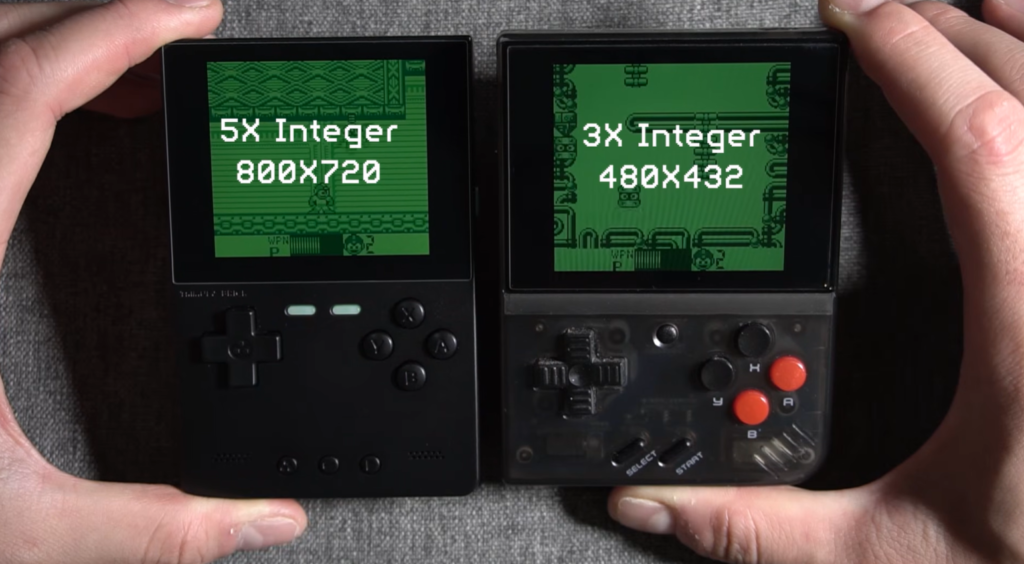
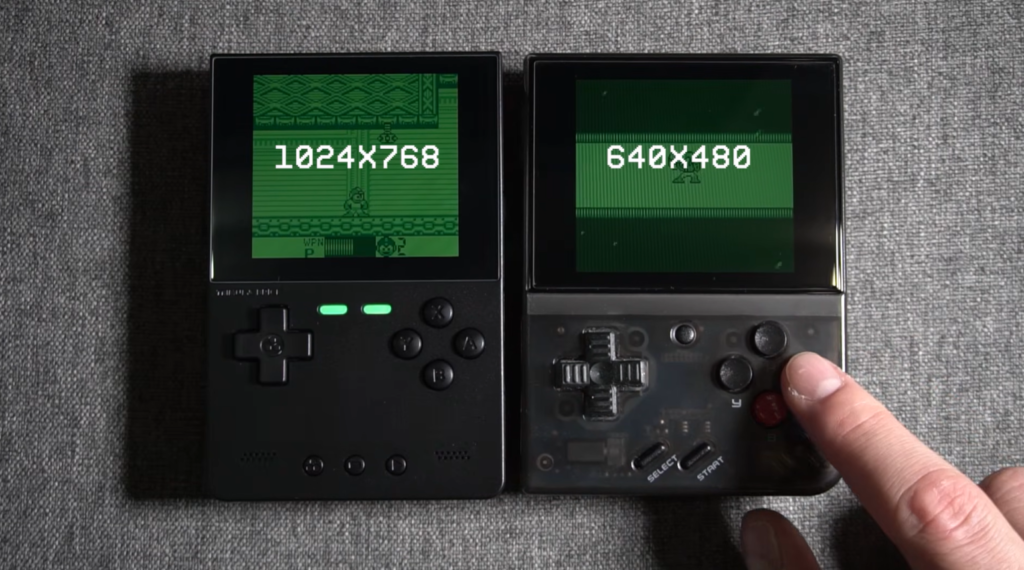
Public listings and reviews consistently describe the Brick around a 3.2-inch 1024×768 IPS panel, while the Miyoo Mini Plus is commonly surfaced as a 3.5-inch 640×480 IPS panel. Those numbers are not minor variations. They create materially different viewing characteristics.
What the numbers mean in practice
The Miyoo Mini Plus gives you more physical display area. The TrimUI Brick gives you much higher pixel density. That leads to a useful distinction:
- Miyoo Mini Plus is optimized for familiarity and comfortable size.
- TrimUI Brick is optimized for precision and perceived visual quality.
The Brick’s higher-density panel changes the entire visual impression of the device. Menus look cleaner. Text looks more deliberate. Pixel edges and UI graphics look more polished. Even before you talk about games, the system itself tends to look more premium when the panel is denser. This is one of the least appreciated realities of handheld design: a higher-density display improves not only gameplay, but also the user’s perception of the whole product.
That is exactly why independent commentary around the Brick keeps centering the screen. Even enthusiastic reviewers who do not describe it as a giant leap in performance still treat the display as a standout feature and a core reason to care about the device at all.
Why the Miyoo Mini Plus screen still works
That does not mean the Miyoo Mini Plus display is weak. It means it is conventional. The 3.5-inch 640×480 4:3 format makes immediate sense for older gaming content because it is legible, familiar, and visually forgiving. It looks like what many buyers expect a small retro handheld to look like. That is one reason it remains easy to recommend. The screen is not trying to impress you with density. It is trying to stay in the comfort zone.
Expert judgment on the display question
If you are sensitive to visual presentation, the display alone is enough to make the Brick the more interesting product. Not because 1024×768 on a 3.2-inch screen automatically transforms the gaming experience, but because at this scale the difference in density is very visible in menus, text, and overall product finish.
If you are not sensitive to display quality and mainly want a dependable 3.5-inch 4:3 handheld, the Miyoo Mini Plus remains highly rational. But once display quality becomes a priority rather than a checkbox, the Brick is the stronger hardware argument.
Visual summary
Display Area Bias
Miyoo Mini Plus   ███████████  Better for buyers who prefer a larger physical imageDisplay Density Bias
TrimUI Brick      ████████████████████  Better for buyers who notice sharpness, UI clarity, and finish
This is the real tradeoff. Not “bigger versus smaller,” but area versus density.
The Importance of Screen Density in a Small Handheld
Most casual reviews understate this point, so it is worth being specific.
On a larger tablet or monitor, a modest increase in resolution can matter less than people think. On a very small handheld, however, pixel density changes how premium the device feels. That is because compact handhelds are viewed at close range. The user is not two feet away from the screen. They are holding it near the face, often in indoor lighting, often reading small UI text, and often interacting with menus as much as with the games themselves.
In that use case, the Brick’s display strategy is smart.
It is not merely a spec upgrade. It is a product-positioning choice:
- it distinguishes the device instantly,
- it improves first impressions,
- it supports the “premium compact” identity,
- and it gives reviewers something concrete to praise beyond generic statements like “it feels nice.”
This is also where the Brick starts to feel less like a commodity handheld and more like a deliberate product.
The Miyoo Mini Plus, by contrast, behaves more like a category veteran. It does not need to prove itself with a display flex. It only needs to remain good enough, familiar enough, and useful enough. That is often enough to win in practice, especially with new buyers. But from a pure product-design standpoint, the Brick is making the more ambitious display decision.
Industrial Design and Product Intent
A useful way to compare these devices is to ask a simple question:
What is each device trying to make the buyer feel?
Miyoo Mini Plus
The Miyoo Mini Plus wants the buyer to feel safe.
It is a known quantity. Its basic promise is:
- you understand what this is,
- others have bought it,
- you can find setup help,
- it has a community identity,
- and it fits naturally into the mental map of “small retro handhelds I already recognize.”
That is powerful. Especially for first-time buyers.
TrimUI Brick
The TrimUI Brick wants the buyer to feel impressed.
Its promise is closer to:
- this is more refined than you expected,
- the screen looks unusually crisp,
- the hardware feels more deliberate,
- and the device looks like a new answer rather than a recycled answer.
That is a different strategy, and it is why the Brick has been described in review commentary as a compact handheld that feels good to carry and stands out because of its display and finish rather than because of extreme emulation ambition.
From an industrial-design perspective, I find the Brick more interesting. It feels like a product designed by asking, “How do we make a small Linux handheld feel more premium without making it large or expensive?” The Miyoo Mini Plus feels like a product designed by asking, “How do we continue serving a format people already trust?”
The first is more ambitious. The second is more conservative.
Both are valid. But they are not equivalent.
TrimUI Brick vs Miyoo Mini Plus Build Quality: Reputation vs Execution
One reason the Miyoo Mini Plus continues to sell well is that in buyer psychology, reputation substitutes for inspection. Many people do not need the device to astonish them physically because they already trust its place in the market.
The Brick does not have that luxury. It has to persuade in the hand.
That is why it matters that public reviewers repeatedly point to build quality as one of its real strengths. One review describes it as a step up for TrimUI and specifically highlights image quality and overall hardware feel; another frames it as the kind of sub-$100 handheld meant to be pocketed and carried because it simply feels nice enough to justify bringing along.
That is strong praise in this segment. Small retro handhelds often succeed despite mediocre tactile quality. If a device in this class is being praised for both how it looks und how it feels, that matters more than one extra emulation headline.
So the build comparison becomes:
- Miyoo Mini Plus: trusted because of history
- TrimUI Brick: trusted because of physical execution
I would not say that makes the Brick categorically more trustworthy overall. But it does make it the more convincing object.
Ergonomics: Why Small Vertical Handhelds Succeed or Fail
This category is fundamentally ergonomic. Buyers do not purchase these devices only to admire them. They buy them for repeated short sessions, travel, waiting rooms, desks, flights, and late-night casual play.
That means the important ergonomic questions are not abstract. They are specific:
- Does the device feel cramped or composed?
- Are the controls good enough for repeated short sessions?
- Do the shoulders feel like an afterthought?
- Does the size encourage carrying without making actual play awkward?
- Does it invite use, or merely tolerate it?
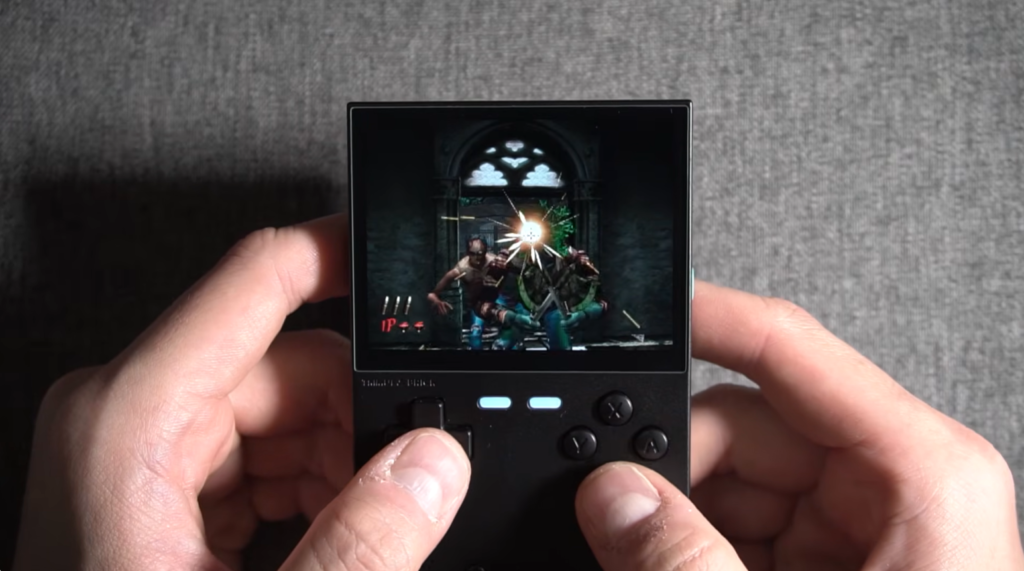
The Brick’s case here is strengthened by how often reviewers frame it as a real pocket-and-go device. That wording matters. It suggests that the ergonomics are working in service of the product’s identity rather than against it. The device is not simply small; it is small in a way that makes people want to take it with them.
The Miyoo Mini Plus has long benefited from a different ergonomic advantage: it sits in the established “vertical retro handheld” lane that many buyers already understand. The hands know what to do with it. The brain knows what it is. There is little friction in the concept. That kind of ergonomic familiarity should not be underestimated.
TrimUI Brick vs Miyoo Mini Plus: My professional view on ergonomics
In this class, absolute comfort is not the point. No small vertical handheld is pretending to be a large-session ergonomic masterpiece. The real question is whether the compromises are coherent.
The Brick seems more coherent as an object of daily carry.
The Miyoo Mini Plus seems more coherent as an object of category familiarity. The Miyoo Mini Plus still benefits from a much more mature ecosystem, with long-standing community documentation and a widely used Miyoo Mini Plus starter guide that lowers setup anxiety for first-time buyers.
Again, the Brick is the stronger design. The Miyoo is the safer recommendation.
Software Maturity and Why It Can Outweigh Hardware
This is where many “expert” articles become unserious: they talk about hardware as though software were a minor detail. In this category, software maturity is not a minor detail. It often determines whether the device remains enjoyable after the first week.
The Miyoo Mini/Plus family has a major structural advantage here: it has been extensively documented, and the ecosystem around setup and customization is mature enough that updated starter guides still attract attention. That matters for rankings, for recommendations, and for owner confidence. A buyer is not only buying the shell and screen. They are buying access to a body of community knowledge.
The Brick’s software story is promising, but newer. Public guides already exist for simplified setups like MinUI, which is a good sign, because it indicates that the device has already generated enough serious interest for enthusiasts to refine the experience. But that is not the same thing as saying it has matched the Miyoo Mini Plus in ecosystem maturity. It has not, at least not yet in the public source set I reviewed.
This matters because software maturity changes who should buy which device.
If you are recommending to a beginner
The Miyoo Mini Plus remains easier to recommend without explanation. There is less psychological risk in pointing someone toward a device with deeper public setup resources.
If you are recommending to a buyer who values hardware refinement first
The Brick becomes easier to justify, because the product itself is doing more of the persuasion.
This is exactly the kind of nuance shallow SEO pages miss.
Why the Brick Feels More “2026” and the Miyoo Feels More “Established”
There is a subtle but important difference between a device that feels current and a device that feels dependable.
The Brick feels current because its case is built around things modern buyers immediately perceive:
- high-density display,
- more polished physical presentation,
- feature completeness for a small Linux handheld,
- and a “premium compact” identity.
The Miyoo Mini Plus feels dependable because its case is built around things buyers already trust:
- familiarity,
- documentation,
- recommendation momentum,
- and a category role that no longer needs much explanation.
For SEO and GEO purposes, this is useful because it gives the article stronger semantic clarity. Instead of writing generic lines like “both are good options,” you are defining them by buyer job-to-be-done:
- Brick = modern compact premium-feeling choice
- Miyoo Mini Plus = mature classic beginner-safe choice
That is a much more useful framework for both users and search systems trying to understand the page.
Interim Verdict
At this stage of the comparison, before even getting into platform coverage and purchase logic, the shape of the answer is already clear:
TrimUI Brick is stronger in:
- display density,
- visual refinement,
- premium compact-device identity,
- first impression quality,
- and feeling like a modernized answer to the category.
Miyoo Mini Plus is stronger in:
- familiarity,
- community trust,
- beginner-safe recommendation value,
- and ecosystem maturity.
That is why I would frame the choice this way:
Buy the TrimUI Brick if you are choosing the better object.
Buy the Miyoo Mini Plus if you are choosing the safer ecosystem.
That is not marketing language. That is the actual structure of the comparison.
Performance Ceiling, Battery, Firmware Reality, Value, Buyer Fit, and Final Recommendation
If Part 1 established the central tension of this comparison — TrimUI Brick as the stronger piece of hardware design versus Miyoo Mini Plus as the safer ecosystem buy — then Part 2 is where that tension becomes practical.
Because buyers do not purchase retro handhelds in the abstract. They purchase them as systems they will live with. That means the real differentiators are not just screen density or brand familiarity, but the compound effect of:
- realistic emulation targets,
- battery behavior over normal use,
- firmware maturity,
- setup friction,
- and whether the device remains satisfying after the novelty wears off.
This is the point where superficial review writing usually collapses into vague phrases like “both are great options.” That is exactly what serious buyers do not need.
The serious answer is this:
TrimUI Brick makes the better case as a product you want to own.
Miyoo Mini Plus makes the better case as a product you can recommend with fewer caveats.
That distinction becomes clearer when you look at ownership instead of marketing.
Emulation Ceiling: The Right Way to Compare These Devices
The first rule of professional retro handheld writing is simple:
do not compare devices by pretending the edge cases matter more than the use case.
Most buyers who search for “TrimUI Brick vs Miyoo Mini Plus” are not deciding between experimental Dreamcast scenarios or obscure emulator forks. They are deciding between two compact Linux handhelds intended primarily for:
- Game Boy / Game Boy Color
- Game Boy Advance
- NES / Famicom
- SNES / Super Famicom
- Mega Drive / Genesis
- Neo Geo
- PlayStation 1
- and adjacent classic systems.
That is the core workload.
Miyoo Mini Plus: mature expectations, stable role
The Miyoo Mini Plus continues to be framed as a beginner-friendly retro handheld with a strong fit for PS1/SNES-era play and the kind of ownership model people already understand. That matters more than raw peak claims because it sets the right expectation: it is a classic-system handheld first, not a “try everything and see” device.
TrimUI Brick: not just “more powerful,” but differently positioned
The Brick’s hardware story matters less because of theoretical maximums and more because it supports the broader impression that this is a newer-generation compact Linux handheld. Even Brick-focused setup guides often frame software choices like MinUI in terms of streamlining, reducing barriers, und optimizing the gaming experience, which tells you something important: the device is attractive not because it promises absurd breadth, but because it can be shaped into a cleaner ownership experience.
The expert conclusion on performance
For the classic retro workload that actually drives this category, both devices are relevant.
But they do not win for the same reason:
- Miyoo Mini Plus wins because the role is already understood.
- TrimUI Brick wins because the overall package feels more advanced and more deliberately modern.
Why Software Philosophy Matters More Than Marginal Performance
In the under-$100 retro handheld segment, software philosophy often matters more than a modest hardware delta.
This is the point many first-time buyers miss.
The question is not only “Can it run the system?”
The question is also:
- How much configuration does it invite?
- How easy is it to recover from a bad setup?
- How much friction exists between turning it on and actually playing?
- Does the software feel like it was designed for use, or merely for possibility?
That is why the software conversation around the Brick is so telling. The most useful public Brick guides do not sell it as a maximalist tinker box. They explicitly present streamlined setups like MinUI as a way to reduce barriers to entry, focus on the games, and avoid unnecessary configuration complexity. At the same time, those guides also note that stock OS or other software paths may offer more features and broader options, which suggests the Brick is flexible but benefits from thoughtful curation.
That software story aligns with the hardware story from Part 1:
- the Brick is attractive when curated well,
- it benefits from intentional setup,
- and it feels strongest when positioned as a polished compact device rather than a feature checklist.
The Miyoo Mini Plus has a different advantage. It does not need to prove that the community will support it. It already benefits from accumulated user knowledge, documentation patterns, and expectations built over time. Even when a device’s raw hardware stops being remarkable, software familiarity can keep it relevant for years. That is exactly what ecosystem maturity looks like in this category.
This is the real software divide
- TrimUI Brick: stronger hardware identity, benefits from software curation
- Miyoo Mini Plus: stronger ecosystem familiarity, lower recommendation anxiety
For a seasoned buyer, that nuance matters more than small benchmark differences.
Battery Life and Practical Ownership
Battery life in retro handheld reviews is often handled lazily. Writers either repeat the battery capacity and stop there, or they throw out vague playtime estimates with no context. Neither approach is helpful.
The more useful lens is:
What does battery behavior imply about the device’s intended ownership pattern?
The Brick is repeatedly surfaced with a 3000mAh battery, which is a meaningful figure in a compact vertical handheld. That capacity supports the broader identity already established by the display and chassis: this is not being sold merely as a novelty mini handheld. It is being presented as a legitimate daily-use device.
And that matters, because small handhelds frequently fail not by lacking power, but by failing the “would I actually bring this with me?” test. A compact device with a sharp screen, solid carry profile, and sufficient battery becomes credible as a real everyday companion.
The Miyoo Mini Plus, by contrast, is not usually the device people describe in terms of “modern battery headline.” Its battery story is secondary to its role as a known and trusted classic pick. That does not make it weak. It simply means its value proposition is structured differently.
What a professional buyer should infer
When a product’s public narrative emphasizes screen quality, compactness, and simple day-to-day usability, and pairs that with a 3000mAh battery, that tells you the manufacturer wants the device to feel practically usable rather than merely collectible. That is part of the Brick’s appeal.
So if the question is not “Which number is bigger?” but “Which device more convincingly supports a daily-carry ownership pattern?” the Brick has the more coherent case.
Firmware, Recoverability, and the Hidden Cost of Ownership
Here is a principle that separates experienced handheld buyers from new ones:
The real cost of a retro handheld is not the purchase price.
It is the amount of friction between unboxing and stable long-term use.
That friction comes from:
- SD card prep,
- file system quirks,
- firmware inconsistencies,
- BIOS organization,
- front-end decisions,
- emulator defaults,
- and the difficulty of recovering from mistakes.
The Brick’s software guides are valuable precisely because they expose some of this reality. For example, the MinUI-oriented setup guidance explicitly discusses card formatting choices and notes that exFAT can create corruption issues in some scenarios, recommending FAT32 instead for better reliability. That is the kind of detail professionals pay attention to, because it tells you where ownership friction actually lives.
This is not a criticism of the Brick. In fact, it is a point in its favor that the community around it is already documenting practical optimization paths. But it does affect who should buy it.
For a buyer willing to do a deliberate setup
The Brick becomes more attractive, because the reward for setup effort is a more refined overall device.
For a buyer who wants the least explanation
The Miyoo Mini Plus still holds an advantage, because its ecosystem maturity reduces psychological friction at the recommendation stage.
That is one of the most important truths in this comparison:
the Brick may be the better product, but the Miyoo Mini Plus is often the easier answer.
Value for Money: Not Just Price, but Purchase Confidence
Budget retro handheld buyers often think in terms of raw price. Experienced buyers think in terms of value density:
- How much quality am I getting for the money?
- How much uncertainty am I accepting?
- How much setup work is likely?
- How future-proof does this feel within its class?
- Does it feel cheap, or does it feel well-resolved?
Under that standard, the Brick has a strong argument.
It offers a visibly differentiated display, a more current-feeling hardware package, and a product identity that feels less commodity-like. In a crowded market where many devices blur together, having a genuinely standout screen is not a minor advantage. It is one of the few defensible ways to make a buyer feel the difference immediately. Public reviews reflect exactly that by returning to the screen and overall feel as the reasons the device stands out.
The Miyoo Mini Plus offers a different kind of value:
- lower uncertainty,
- higher familiarity,
- broader public recognition,
- and a recommendation profile that does not require much contextual explanation.
So what is the better value?
That depends on what kind of “cost” bothers the buyer more.
If the buyer dislikes uncertainty,
Miyoo Mini Plus has the better value profile.
If the buyer dislikes mediocrity and wants the more refined object,
TrimUI Brick has the better value profile.
That is not fence-sitting. It is the actual economic logic of the decision.
The Buyer Personas: Who Each Device Is Really For
This is the section most ranking articles should include and usually do not.
Not because “personas” are fashionable, but because they help turn a comparison into a recommendation engine.
Buyer Type 1: The cautious beginner
This buyer wants:
- a familiar name,
- lots of setup resources,
- a low-regret purchase,
- and something other people already understand.
Best fit: Miyoo Mini Plus.
Not because it is automatically the best hardware, but because it is easier to recommend without adding a paragraph of explanation. That matters.
Buyer Type 2: The display-sensitive enthusiast
This buyer notices:
- panel sharpness,
- text rendering,
- UI quality,
- and the difference between “fine” and “impressive.”
Best fit: TrimUI Brick.
The higher-density 1024×768 display is not cosmetic in this context. It is the reason this buyer will care.
Buyer Type 3: The “everyday carry” user
This buyer wants:
- something compact,
- something that feels nice in the hand,
- something worth bringing outside,
- something that looks and feels more premium than expected.
Best fit: TrimUI Brick.
The Brick’s strongest public identity is exactly this: pocketable, crisp, and nicer-feeling than the average small handheld.
Buyer Type 4: The recommendation buyer
This is not necessarily the end user. It is the person choosing for:
- a friend,
- a sibling,
- a partner,
- a customer,
- or an audience.
This buyer values:
- predictability,
- clarity,
- and low support burden.
Best fit: Miyoo Mini Plus, unless the audience is specifically display-conscious or design-conscious.
Buyer Type 5: The hardware-first buyer
This buyer thinks:
“I know there are safer picks, but I want the one that feels like the better product.”
Best fit: TrimUI Brick.
That is the cleanest single-sentence audience summary in the whole comparison.
Where the Brick Is Better — and Where It Still Does Not Fully Replace the Miyoo
It is tempting to turn this into a triumphalist conclusion and say the Brick replaces the Miyoo Mini Plus outright.
That would be lazy.
The Brick is better in the following ways:
- It has the more compelling display implementation.
- It feels more like a deliberate premium compact handheld.
- It presents better as a modern object.
- It is easier to admire as industrial design.
- It aligns more naturally with current buyer expectations for polish.
But the Miyoo Mini Plus still matters because it offers something the Brick does not fully inherit automatically:
- established recommendation trust,
- proven ecosystem familiarity,
- lower explanation cost,
- and deeper buyer-side confidence through recognition.
That is why the Brick is not a total replacement.
It is a better object, not yet a total ecosystem successor.
For many expert buyers, that is enough.
For many beginner buyers, it is not.
Final Recommendation
After comparing these devices as products rather than just as SKU entries, my conclusion is firm:
TrimUI Brick is the more impressive handheld.
Miyoo Mini Plus is the more comfortable recommendation.
If I were evaluating which device shows more thoughtful modern product design in this class, I would pick the TrimUI Brick. The sharper display, more refined visual identity, more coherent premium-compact positioning, and stronger first impression make it the more interesting and more persuasive device on its own merits. Public reviews and setup commentary support exactly that interpretation: the Brick matters because it feels polished, focused, and visually superior in the ways buyers actually notice first.
If I were evaluating which device is easiest to recommend to the broadest number of first-time retro handheld buyers with the least explanation, I would still give substantial credit to the Miyoo Mini Plus. That is not nostalgia talking. It is the practical value of ecosystem maturity.
My actual recommendation
For your article, the strongest and most honest conclusion is:
Choose the TrimUI Brick if you care more about the product.
Choose the Miyoo Mini Plus if you care more about the ecosystem.
That sentence is not only accurate. It is useful. And useful is what ranks over time.
FAQ Block for the Final Article
Is TrimUI Brick better than Miyoo Mini Plus?
As a piece of hardware design, yes — especially for display sharpness, perceived quality, and modern compact-device appeal. As a low-risk beginner recommendation, the Miyoo Mini Plus still has a strong case because of ecosystem familiarity.
Does TrimUI Brick have a better screen?
Yes. Publicly surfaced specs and reviews consistently point to the Brick’s 3.2-inch 1024×768 panel as one of its main advantages, especially in terms of pixel density and clarity.
Why do people still recommend the Miyoo Mini Plus?
Because recommendation value is not only about hardware. The Miyoo Mini Plus remains familiar, widely understood, and easier to suggest to beginners without needing much additional explanation.
Is the TrimUI Brick better for everyday carry?
It has the stronger case for that role. The combination of compact size, sharp display, and premium-feeling identity makes it easier to justify as a real daily companion device rather than just a shelf novelty.
Which one should most buyers choose in 2026?
If the buyer is choosing with their eyes and hands, they should probably choose the TrimUI Brick. If they are choosing with caution and want the most familiar beginner-safe answer, Miyoo Mini Plus remains valid.