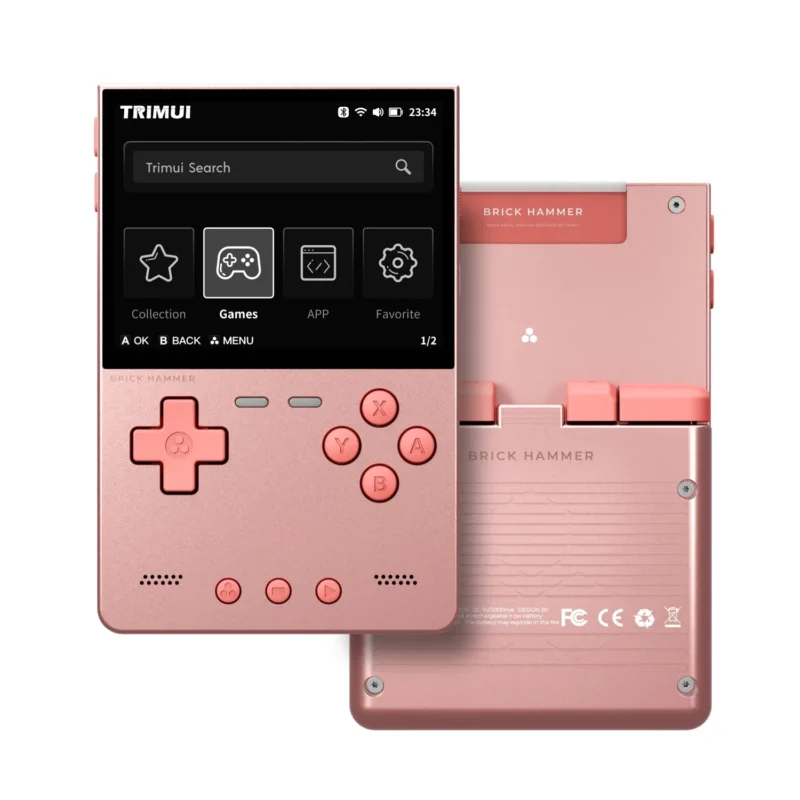
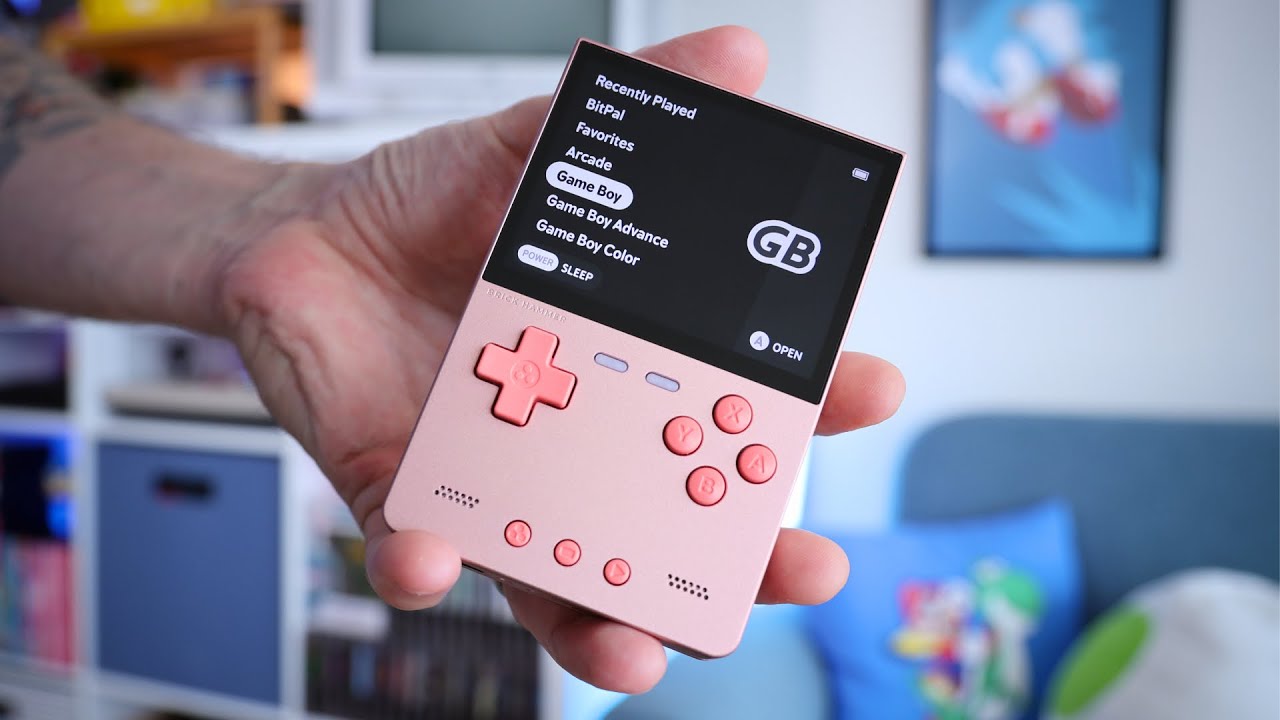
Some handhelds are easy to understand the moment you pick them up. The Trimui Brick Hammer is one of them. It does not arrive with a brand-new chipset, a larger screen, or some dramatic redesign. Its entire pitch is much simpler: take a handheld people already liked, wrap it in metal, and charge extra for the upgrade.
That sounds straightforward, but it creates a more interesting question than it first appears. A lot of retro handheld buyers are not just shopping for performance. They are shopping for feel, convenience, daily portability, and that hard-to-explain sense that a device belongs in the hand instead of sitting on a shelf. The Trimui Brick Hammer sits right in that space. It is trying to be the nicer version of a device that was already considered one of the better small handhelds in its price range. According to the transcript, the Hammer keeps the same core platform as the original Trimui Brick, including the Allwinner A133 Plus chip, 1GB of RAM, 8GB of internal storage for firmware, a 3.2-inch 1024×768 display, 3000mAh battery, Linux-based software foundation, stereo front-firing speakers, Wi-Fi, and Bluetooth. The major hardware change is the metal shell.
That makes this device easy to misunderstand.
If someone lands on the Trimui Brick Hammer expecting a major generational leap, they may come away disappointed. If they understand it as a premium reworking of a compact retro handheld that already had a strong reputation, the conversation changes. Then the questions become more practical. Does the metal shell actually improve the experience? Does it make the handheld feel better in daily use? Does it introduce new trade-offs? And most importantly, is the higher price justified when the cheaper plastic model can do the same jobs?
This is where the Trimui Hammer gets interesting, because it is not really competing against the whole retro handheld market first. It is competing against its own sibling.

Why the Trimui Brick Hammer Is Getting Attention
The original Trimui Brick built its reputation around something simple but difficult to get right: it was small, sharp-looking, genuinely pocketable, and had a display that felt better than expected for its size. The transcript describes it as one of the reviewer’s favorite small handhelds around the $60 price point, with the screen being the biggest draw.
That matters because compact handhelds usually ask you to compromise somewhere. Sometimes the buttons feel cramped. Sometimes the battery is underwhelming. Sometimes the screen is merely acceptable. Sometimes the whole device feels like a toy rather than something you want to carry every day. The original Brick seems to have avoided most of those traps, which is why a metal version immediately gets attention from collectors and everyday users alike.
The Hammer enters the conversation as a more premium version, with pricing in the roughly $90 to $100 range in the transcript, compared with the original Brick often selling far lower depending on availability and promotions. That price jump changes how people evaluate it. The plastic Brick could be judged as a value pick. The Hammer has to survive a tougher question: not “Is this good?” but “Is this better enough?”
For handheld fans, that difference is everything.

First Impressions: What Actually Changed From the Original Trimui Brick
The easiest way to talk about the Trimui Brick Hammer is to start with what did not change. The chipset is the same. The screen is the same size and resolution. The core layout is the same. The buttons and general form factor are the same. Even the box is essentially the same, aside from stickers marking it as the Hammer version. The subtitle of the whole device could almost be: same handheld, different body.
In practice, though, enclosure material changes more than spec sheets suggest.
Metal changes temperature behavior. It changes perceived weight. It changes the way buttons feel when they bottom out against the shell. It changes how “premium” the handheld feels in a pocket or in the hand. It also changes expectations. A plastic handheld can get away with feeling playful. A metal handheld has to feel intentional.
From the description in the transcript, the Hammer mostly succeeds on that front. The shell gives it a tougher, more solid presence, and the increased weight is noticeable without becoming excessive. The reviewer notes that the metal version weighs 192 grams versus about 161 grams for the plastic version, a difference of roughly 31 grams. Even with that increase, it stays under 200 grams and still feels small enough to remain an everyday carry handheld.
That point should not get lost. Plenty of handhelds are “portable” in the technical sense. Fewer are the kind you actually want in a pocket while going about a normal day. The Trimui Brick line still seems to live in that narrower category.

Design and Build Quality
Metal shell and finish
A metal shell is easy to market, but it only matters if it improves the experience beyond photographs. Here, the appeal is not only visual. It is tactile. The Hammer seems to benefit from that added density and rigidity that makes many metal handhelds feel more serious the second you pick them up. The transcript repeatedly points to a more premium feel, not because the design changed dramatically, but because the interaction between the plastic buttons and the metal housing gives the device a more refined feel during play.
That is the kind of upgrade that rarely shows up in bullet-point marketing. It is also the kind of change enthusiasts often care about most.
There are some cosmetic touches specific to the Hammer as well. On the back, instead of only the familiar metal panel, there is a separate transparent or lacquered section with the Brick Hammer branding, while the rest of the shell remains predominantly metal. The transcript describes this section as the only plastic part of the shell and notes that it gives the back a slightly different look from the original.
Whether you love that detail may come down to taste, but it does help the Hammer feel like a distinct edition rather than a lazy repaint.

Pocketability and daily carry feel
This is where many retro handheld reviews lose sight of what actually shapes long-term use. A device can have plenty of power and still spend most of its life in a drawer if it is annoying to carry. The reason the Brick line built goodwill is not just because it plays retro games well enough. It is because it stays easy to bring along.
The Hammer does not ruin that. In fact, according to the transcript, that portability remains one of the best things about it. The reviewer still considers it an everyday carry device and emphasizes that the small, pocketable form factor is the part of the Trimui Brick experience that shines most consistently.
That is a stronger compliment than it first sounds.
A metal body can easily push a small handheld into awkward territory. Too heavy, and it starts dragging at your pocket. Too slippery, and you become more aware of protecting it than using it. Too fragile-looking, and you stop taking it outside. The Hammer seems to avoid most of that. It adds heft, but not enough to erase the original appeal.
This is especially important for the kind of buyer likely to search terms like “Trimui Brick Hammer game handhelds sale” or “Trimui Hammer review.” That person is usually not deciding between this and a high-end Android handheld. They are deciding whether this particular size and style of retro handheld is worth carrying every day. The answer seems to depend less on raw specs and more on whether you value the nicer shell enough to pay extra for it.
Weight difference vs the Trimui Brick
Here is a simple comparison table you can include in the blog for readability:
| Feature | Trimui Brick Hammer | Original Trimui Brick |
|---|---|---|
| Shell material | Metal | Plastic with metal rear section |
| Weight | 192g | 161g |
| Difference | +31g | — |
| Pocketable for daily carry | Yes | Yes |
These details are drawn from the provided transcript, which states that the Hammer weighs 192 grams and the plastic model weighs about 161 grams, with only a 31-gram gap between them.
That 31 grams matters less than you might think. On paper it sounds like a decent jump. In the hand, it sounds like it lands in the range where the extra weight reads as solidity rather than fatigue. For some buyers, that will be enough to justify the upgrade. For others, it will confirm that the cheaper model already had the better balance.
Controls, Buttons, and Everyday Comfort
D-pad and face buttons
The Hammer inherits one of the more distinctive traits of the original Brick: clicky controls that feel crisp and deliberate. That can be a positive or a negative depending on your preferences. The transcript frames the buttons as satisfying and precise, but also acknowledges that some users may find them a little fatiguing because they take more actuation force than softer alternatives.
That kind of honesty matters in a buying guide, because “good buttons” is never universal. Some players love a sharper, more tactile response because it makes platformers, shooters, and menu navigation feel cleaner. Others want softer controls for longer sessions, especially on small handhelds where thumb fatigue appears faster.
The impression here is that the Trimui Brick Hammer stays in the first camp. If you already liked the original Brick’s button feel, there is little reason to think the Hammer will disappoint you. If you disliked the original because the controls felt too clicky, the metal body will not solve that.
What may improve the experience slightly is the shell itself. Plastic-on-metal interaction often feels more defined than plastic-on-plastic. It gives the controls a firmer, more finished sensation, and the transcript explicitly points to that as one of the more meaningful benefits of the Hammer’s body material.

Shoulder buttons and swappable triggers
The top-mounted shoulder and trigger buttons are another area where the device seems to stick closely to the original formula. The buttons remain soft and clicky, and the system still supports swappable shoulder pieces, allowing users to change the shape if they prefer something more rounded or differently angled. The transcript notes that the included alternates are the same as those bundled with the standard Brick.
This might sound like a minor feature, but on compact vertical handhelds, shoulder comfort can make or break the device once you move beyond Game Boy and NES-era play. Even if this is not the ideal system for analog-heavy Dreamcast or N64 titles, shoulder usability still matters for PS1, SNES, and anything else with expanded input demands.
The reassuring part is that these buttons do not appear to be gimmicky. They are functional, customizable, and apparently secure enough not to fall out accidentally in typical use. That is exactly what this sort of feature should be.
Speaker placement and audio quality
Audio is one of the more underrated strengths here. The transcript describes the Brick family as having front-firing stereo speakers, which is still fairly uncommon in smaller handhelds, and notes that sound quality is crisp and clear even if the speakers are naturally limited by the device’s size. The reviewer characterizes the overall audio performance as above average for a handheld of this scale.
That can have more impact on day-to-day enjoyment than a spec list suggests. Front-firing speakers project better toward the player, require fewer grip adjustments, and tend to preserve clarity better than bottom-mounted or rear-mounted alternatives. On a compact device meant for quick sessions, that convenience matters.
A handheld like this is often used in less controlled environments too: couch sessions, travel, short breaks, outdoor play, hotel rooms, airport waiting areas. In those situations, “good enough” audio sometimes feels frustratingly mediocre. Above average is actually a worthwhile selling point.

The Screen: Why It Still Matters More Than the Shell
If the metal shell is the headline upgrade, the display is still the actual reason many people will enjoy using the Trimui Brick Hammer.
That is one of the key lessons from the transcript. The reviewer keeps returning to the same point: the original Brick stood out because of the screen, and that advantage still carries the Hammer. The display remains 3.2 inches at 1024×768, which results in roughly 400 PPI. That is extremely sharp for a retro handheld this size, and the transcript repeatedly emphasizes how that density improves the overall presentation of classic games.
3.2-inch 1024×768 display
A 3.2-inch display does not sound impressive in isolation. For some buyers, it may sound too small. That reaction is understandable. In a market full of 3.5-inch, 4-inch, and even larger retro handhelds, 3.2 inches seems conservative.
But the size alone misses what makes this panel interesting.
Because the resolution is so high for the panel size, the image remains extremely crisp. The transcript argues that the density is high enough that users do not have to obsess over integer scaling, non-integer scaling, or slight stretching issues in the way they might on lower-resolution screens. Games can be enlarged to make better use of the available display space while still looking sharp.
That is a practical advantage, not just a technical one. It means less fiddling and more playing.
Brightness, sharpness, and outdoor use
Another point that deserves more attention in search-focused blog content is brightness. A handheld designed around portability should not become useless the moment you leave the house. The transcript describes the screen as bright enough for outdoor play, while also noting that it is somewhat reflective, so direct sunlight can still create visibility issues depending on the environment. Shade improves the experience significantly.
That feels believable because it is balanced. It does not pretend the display is magical outdoors. It simply sounds usable in real-world conditions, which is often exactly what buyers need to know.
For a device that still makes sense as a pocket companion, that brightness matters more than it would on a larger handheld meant mostly for indoor couch sessions.
Why scaling looks unusually good on this device
This may be the most quietly important point in the whole screen discussion.
Retro handheld buyers often spend too much time arguing over whether integer scaling is mandatory for clean image quality. On many devices, it is a meaningful concern. Here, the transcript suggests that the screen’s sharpness is so high that non-integer scaling still looks impressively clean on a 3.2-inch panel, especially when using aspect-preserving settings and custom firmware options with crisp scaling features. MinUI and Pack UI are specifically mentioned as offering approaches that keep games looking balanced while using as much screen space as possible.
That flexibility is one reason the Brick line remains easy to recommend despite its compact size. Small screen, yes. Cramped-looking games, not necessarily.
Performance and Emulation Experience
The easiest mistake to make with the Trimui Brick Hammer is to judge it like a spec-first handheld. This is not the device you buy because it promises to dominate every emulator up the ladder. It is the device you buy because it makes a certain kind of retro gaming feel easy to live with.
That said, performance still matters, especially once people start asking whether the metal version does anything beyond changing the shell.
The answer is no, not in raw performance terms. The Hammer uses the same Allwinner A133 Plus platform as the original Brick, along with the same 1GB of RAM and 8GB of internal storage used primarily for the firmware. So the experience here should be understood as familiar rather than upgraded. It is still a Linux-based handheld aimed first at classic systems, with some room to stretch higher if your expectations are in the right place.
What the A133 Plus chip is really good at
This chip has already shown up in other Trimui products, and the transcript frames it in a fairly grounded way: strong enough for PlayStation 1 and below, with some decent performance available on more demanding systems like Dreamcast and Nintendo 64. That is a sensible place to set expectations.
For many retro handheld buyers, that is actually a sweet spot.
There is a point where chasing broader compatibility starts working against the form factor. On a small vertical handheld with a 3.2-inch screen and no analog sticks, not every technically playable system is a system you will truly enjoy playing. The Brick Hammer seems strongest when treated as a compact machine for 8-bit, 16-bit, arcade, PS1-era, and selected lightweight 3D experiences rather than as a pocket-sized everything machine.
That is not a weakness. It is clarity.
The market has plenty of devices trying to be all-purpose emulation tools. A device like this earns its place by being very good at the kind of library people actually want on a small, take-anywhere handheld.
PS1 and below: where the device makes the most sense
If you are building a buying guide around real-world use rather than theoretical compatibility, PS1 and below is where the Trimui Brick Hammer becomes easiest to recommend. The transcript makes that clear more than once. The reviewer treats PlayStation 1 as a comfortable upper bound for the kind of sustained use that fits the hardware best, especially since the smaller body and control layout feel most natural with traditional retro systems.
That lines up with the device’s overall identity.
This is a screen-first, portability-first handheld. PS1, SNES, GBA, Genesis, Neo Geo, arcade libraries, and older Nintendo platforms all make sense here because they suit both the controls and the screen size. They also suit the rhythm of the device itself. Short sessions work. Daily carry works. Save-state style play works. Browsing a compact, curated library works.
The best small handhelds are not the ones that can merely launch a game. They are the ones that make you want to keep coming back to it. The Brick line seems to do that by staying in its lane.
Dreamcast and N64 expectations
This is where blog readers usually want a simple answer, but a more honest one is better.
Yes, the transcript says the hardware can achieve some pretty good performance on systems like Dreamcast and Nintendo 64. But it also makes an equally important point: that is not necessarily the same thing as this being the right device for those systems in regular use. The reviewer specifically notes that the original Brick would warm up enough under heavier load that they generally preferred not to push it too hard, and that the lack of analog sticks makes certain N64 and Dreamcast titles less comfortable anyway. As a result, they personally tended to cap practical use at PS1.
That distinction is exactly the sort of thing people trust in a long-form review.
A search-optimized blog post should not oversell “can run” as “should buy for.” On paper, it is appealing to tell readers that the Trimui Hammer can reach into the Dreamcast and N64 generation. In practice, the smarter takeaway is this:
- It has enough headroom to explore some higher-end systems.
- It is not the ideal form factor for those systems.
- Most buyers will get the best experience by treating them as bonus territory rather than the main reason to buy the device.
That framing protects credibility and makes the buying advice more useful.
Why the lack of analog sticks still matters
This is one of those details that matters more the longer you use the handheld.
For 2D-focused retro libraries, no analog sticks is not much of a problem at all. In fact, some people prefer the cleaner shape and simpler front face on smaller vertical handhelds. But once the conversation moves into late-90s 3D libraries, the absence of analog input becomes a real limitation. The transcript points this out directly in the context of N64 and Dreamcast use.
That is why the Brick Hammer feels better described as a premium retro handheld than a mini all-systems emulator. It can touch higher-end platforms, but it is most at home with systems that suit its size, screen, and control layout.
A good review should respect that boundary instead of trying to stretch the narrative.
Here is a simple performance expectation table you can include in the article:
| System Range | Expected Experience on Trimui Brick Hammer | Notes |
|---|---|---|
| GB / GBC / NES / Genesis / SNES | Excellent fit | Ideal for the form factor |
| GBA / Arcade / PS1 | Very strong | Best balance of visuals and comfort |
| N64 / Dreamcast | Mixed to selective | Some good performance, but not the main reason to buy |
| Analog-heavy 3D titles | Limited fit | No analog sticks changes the experience |
This table is a summary interpretation based on the transcript’s descriptions of chipset capability, practical use, and control limitations.
Software Experience and Firmware Options
One reason the Trimui Brick platform has stayed relevant is that the hardware arrived with enough community interest to attract multiple software options. That matters more than many first-time buyers expect.
A compact handheld lives or dies by friction. If it takes too long to boot, feels clumsy to browse, or turns game management into a chore, it slowly becomes less attractive no matter how nice the shell is. The transcript suggests that the Brick ecosystem has matured enough that buyers can choose the style of experience they want rather than being stuck with one default path.
Trimui Brick Hammer Stock OS: simple enough, but not the whole story
Out of the box, the Hammer boots into stock firmware stored on the device itself. It does not come with an SD card by default, so the owner needs to add ROM files manually unless purchasing a bundled card from a retailer. According to the transcript, setup is relatively easy, but it assumes you already have your own game files and are comfortable managing them.
That is an important point for SEO readers because many buyers of retro handhelds fall into two different groups:
The first group likes that flexibility. They want to manage their own library, choose firmware, scrape art, and keep the device clean.
The second group wants something quicker and more turnkey, even if it is not the purist approach.
The Hammer seems capable of serving both, but not in quite the same way.
Preloaded cards: convenient, but not the cleanest solution
The transcript also talks about retailer-supplied preloaded microSD cards, noting that some stores sell reputable-brand cards with operating systems and ROM collections already prepared. The reviewer points out that this is obviously a legally murky area, even if it can be a timesaver for buyers who want a faster entry point. They also make the sensible recommendation that curating your own library is usually the better long-term route.
That is the right tone for a blog post too. There is no need to turn this into a lecture, but there is also no need to glamorize the preloaded-card ecosystem. The more credible takeaway is that the hardware is flexible, and buyers who want the best experience should think in terms of building a smaller, cleaner library that actually suits how they play.
That idea comes through strongly in the transcript. Instead of dumping thousands of games onto the device, the reviewer prefers to keep a curated selection of roughly 50 titles per system. That may sound restrictive at first, but it reflects something many long-term handheld users eventually discover: too much choice can make a device feel less playable, not more.
Pack UI, MinUI, NextUI, and other alternatives
This is where the Brick Hammer starts to feel more mature than its simple hardware profile might suggest.
The transcript mentions several software environments that work with the Brick family, including Pack UI, MinUI, NextUI, and others, with Pack UI described as the main setup the reviewer has been using over the past several months. It is praised for its simple presentation, box art scraping, and curated-list feel. Other environments are described as more robust, with features like video previews or broader system-level customization.
This flexibility is more valuable than a spec bump would have been.
For a device like the Trimui Hammer, software personality shapes the experience almost as much as the shell. A streamlined front end turns it into a quick-pick handheld you can use between errands or before bed. A fuller interface with scraping and previews gives it more of a mini console identity. The fact that the Hammer can inherit all the software work already done for the original Brick is one of its strongest practical advantages.
And it also reinforces a broader truth: because the Hammer shares its internal platform with the original Brick, the buying decision is not about getting access to a better software future. It is about deciding whether the improved body and premium feel are worth the extra spend.
ROM management and setup expectations
From a usability standpoint, the Trimui Brick Hammer seems approachable, but not truly plug-and-forget unless you pay a retailer to prepare a card. That is not unusual for this category. What matters more is that once configured, the software side does not appear to fight the user.
The best way to frame that for readers is something like this:
- Easy enough for hobbyists and repeat buyers
- Manageable for newcomers willing to learn a little
- Better when curated than when overloaded
- More enjoyable once paired with the right front end
That is a stronger message than pretending it is either fully beginner-proof or annoyingly advanced. It seems to sit in the middle, which is where many good Linux handhelds live.
Heat, Battery, and Real-World Use
This is where the Hammer gets more interesting than a “metal version” summary suggests.
Metal shells always change thermal behavior. Even when actual temperature changes are small, perceived warmth changes a lot. The transcript handles this part well because it separates what the thermal camera showed from what the hands actually felt, and those two things are not identical.
Trimui Brick Hammer Heat behavior: cooler in spots, warmer in feel
On the original plastic Brick, the main complaint seems to have been the concentrated warmth in the metal rear section, which acted like a hotspot during harder use. The Hammer changes that behavior because the shell spreads heat across a larger surface area. As a result, the device can feel more evenly warm rather than cool in one zone and noticeably hotter in another.
According to the transcript, after around 20 minutes of PS1 gameplay, the Hammer showed roughly 31°C across much of the front shell, with a hotter central area near the screen reaching around 36 to 37°C. The plastic model, despite feeling cooler in hand overall, actually produced hotspot readings of around 39 to 40°C, with cooler areas around 32 to 33°C. On the back, the Hammer remained relatively even, while the plastic version still showed a warmer concentrated zone on the upper rear plate.
That is a useful distinction to explain to readers because “runs cooler” is often too simplistic. The metal model may spread the heat in a way that feels warmer even when certain hotspots are technically reduced. The plastic model may feel cooler in your grip while still producing a more dramatic hotspot elsewhere.
For buyers worried that the Hammer will become uncomfortably hot, the transcript’s answer is reassuring: it gets warm, not alarming. It is noticeable, but not framed as a deal-breaker.
Battery life in realistic use
The Trimui Brick Hammer uses a 3000mAh battery, and the transcript gives a practical estimate of around four hours of gameplay on average, depending on what is being played.
That is not outstanding on paper, but it feels appropriate for the type of handheld this is. Small screen, small body, short to medium-length sessions, frequent standby use, portable charging. In real life, that kind of battery figure is workable as long as expectations are aligned with the product category.
It is also worth noting that the transcript praises the device’s charging compatibility. Unlike some cheaper handhelds that can be fussy with chargers and cable types, this one reportedly charged properly using a USB-C to USB-C cable on a 125W fast charger. That kind of compatibility sounds minor until you have used devices that refuse to behave unless paired with older, lower-spec chargers.
That practical convenience adds up over time.
Real-world daily use: where the handheld makes the most sense
If you strip away the collector appeal, the most convincing case for the Hammer is still everyday portability. The transcript returns to this repeatedly, describing the Brick family as a genuinely pocketable device that works well as an everyday carry handheld.
That gives the Hammer a clearer role than many mid-tier emulation devices have. It is not the couch king. It is not the Android powerhouse. It is not the best one-device solution for every emulator. It is the kind of handheld you keep nearby because it disappears into daily life more easily than larger alternatives do.
That may end up mattering more than the shell material itself.
Trimui Brick Hammer vs Trimui Brick
This is the section many readers will scroll to first, and it deserves a clear answer.
The Trimui Brick Hammer and the original Trimui Brick are much closer than their price difference suggests. The internal hardware is effectively the same. The screen is the same. The controls are the same. The software ecosystem is the same. The general use case is the same. The Hammer’s identity is built almost entirely around the metal shell, the premium feel, the slightly changed thermal character, and the visual appeal of the upgraded body.
That means the choice comes down to value and taste more than function.
Here is a side-by-side comparison table you can keep in the article:
| Category | Trimui Brick Hammer | Original Trimui Brick |
|---|---|---|
| Shell | Metal | Plastic |
| Weight | 192g | 161g |
| Screen | 3.2-inch 1024×768 | 3.2-inch 1024×768 |
| Chipset | Allwinner A133 Plus | Allwinner A133 Plus |
| RAM | 1GB | 1GB |
| Internal storage | 8GB | 8GB |
| Main appeal | Premium feel, metal body | Better value |
| Practical performance | Essentially the same | Essentially the same |
| Recommended for | Collectors, premium-build fans | Most buyers |
These hardware and pricing comparisons are derived from the transcript’s direct descriptions of the two models.
When the Trimui Brick Hammer makes more sense
The Hammer is easier to justify if any of the following apply:
- You already know you love the Brick form factor
- You care about metal handhelds as objects, not just tools
- You want the more premium version of a design you already trust
- You collect retro handheld variants and appreciate fit-and-finish upgrades
In other words, the Hammer makes more sense for enthusiasts than for bargain hunters.
When the plastic Brick makes more sense
The standard Brick sounds like the more rational buy for most people, especially those entering the category for the first time. The transcript says this pretty directly: if you are just getting started and want one of these devices, the cheaper plastic Brick is likely the better bet because it does all the same things while costing significantly less.
That is probably the most important conclusion in the whole review because it avoids the trap of forcing the premium option to win.
Sometimes the best way to make an article persuasive is not to oversell the expensive version.
Who Should Buy the Trimui Brick Hammer
The strongest product pages and SEO reviews do not try to convince everyone. They sort the right buyers from the wrong ones.
The Trimui Brick Hammer makes the most sense for three kinds of people.
1. Retro handheld fans who care about materials and feel
Some buyers are perfectly happy with plastic. Others notice shell material every time they pick up a device. If you fall into the second category, the Hammer is easier to appreciate. The premium feel is not imaginary. The transcript makes that clear enough. The shell changes how the handheld feels in the hand, how the buttons bottom out, and how “special” the product feels compared with the regular Brick.
2. Players who want a genuinely pocketable retro machine
This is not a pretend-portable handheld. It is small enough to remain relevant as an everyday carry option, which is a bigger deal than many spec-heavy reviews acknowledge. If your gaming habits include short sessions away from home, this size still has a lot going for it.
3. Buyers who mainly want PS1 and earlier systems in a refined package
If your library is built around Game Boy, SNES, PS1, arcade games, and similar systems, the Brick Hammer is working in its comfort zone. If your goal is Dreamcast-first, N64-heavy, or analog-centered emulation, there are better-suited devices in the market.
Final Verdict
The Trimui Brick Hammer is not the kind of upgrade that wins on numbers alone.
It is a premium shell version of a handheld that was already good at what it did. The screen is still one of the strongest parts of the package. The controls still feel deliberate and tactile. The software ecosystem is still one of the reasons the platform remains easy to like. The performance profile is still best understood as PS1-and-below first, with some extra room beyond that if expectations stay realistic. And the compact shape still makes it more useful in daily life than a lot of technically stronger handhelds.
The part that complicates the recommendation is price.
If the Hammer sits far above the standard Brick in cost, the plastic model remains the smarter buy for most people. It delivers nearly the same practical experience and keeps the same strengths. The Hammer becomes easier to justify only if the metal body is exactly what you want: not as a performance upgrade, but as a finish-and-feel upgrade.
That does not make it a bad product. It just makes it a more specific one.
And in a crowded retro handheld space, specificity is not always a weakness. Sometimes it is the reason a device ends up with loyal fans.
FAQ
Is the Trimui Brick Hammer more powerful than the original Trimui Brick?
No. Based on the provided transcript, it uses the same core hardware as the original Brick. The main change is the metal shell rather than a performance upgrade. More details please check: Here.
Is the Trimui Hammer worth buying over the plastic Trimui Brick?
It depends on what you value. If you want the better-value option, the plastic model is likely the smarter purchase. If you specifically want a more premium-feeling metal version of the same device, the Hammer is the one to look at.
What systems does the Trimui Brick Hammer handle best?
The transcript suggests it is strongest with PS1 and below, while also offering some decent performance on selected Dreamcast and N64 use cases.
Does the Trimui Brick Hammer get hot?
It gets warm, but the transcript does not describe it as uncomfortable during normal use. The metal shell spreads heat more evenly, which can make it feel warmer overall even if hotspot behavior differs from the plastic model.
Does it come with games?
According to the transcript, the device does not come with an SD card by default. Users typically need to add their own game files unless they buy a separately prepared card from a retailer.
Is the screen really that good for a small handheld?
The screen appears to be one of the biggest strengths of the device. The transcript highlights the 3.2-inch 1024×768 panel and its high pixel density as one of the key reasons the Brick line stands out.
If you want a compact retro handheld with a sharper-than-expected screen, a premium metal shell, and a form factor that still makes sense for everyday carry, the Trimui Brick Hammer is an easy device to be curious about. It is not the cheapest way into the Brick lineup, but for buyers who care about feel as much as function, it has a distinct appeal.
Browse the latest Trimui Brick Hammer options here:
Trimui Brick Hammer collection
https://trimuibrick.com/product-category/trimui-hammer/
Trimui Brick Hammer picks
-
TRIMUI BRICK Hammer Handheld Game Console 3.2”IPS Screen CNC Aluminum Alloy A133P Linux OS LED Lighting Free Keycap Palyer Gift (Silver)
Gamme de prix : $109.00 à $139.00 -
TRIMUI BRICK HAMMER Handheld Game Console Retro Video Games 3.2” IPS Screen Full Metal CNC Linux System Portable Console (Black)
Gamme de prix : $109.00 à $139.00 -
TRIMUI BRICK Hammer Handheld Player with CNC Aluminum Alloy Body, Linux System and RGB LED Lighting (Green)
Gamme de prix : $109.00 à $139.00 -
TRIMUI Brick Hammer Portable Handheld Game Player CNC Full Metal 3.2” IPS Screen Retro Games Linux System Video Gaming Device (Gold Pink)
Gamme de prix : $109.00 à $139.00